
A History of Violence Re-review

A family man’s shady past comes calling after an act of heroism in this thoughtful mediation on violence.
“…Ask him why he’s so good at killing people.” – Carl Foggarty, with A history of Violence’s central question.
It’s a difficult one to review, A History Of Violence, without giving away it’s central twist. I normally manage to avoid spoilers when I’m talking about the films I review, even if that means discussing abstract themes rather than specific details of the films themselves. In this instance, the films central reservation is tied into it’s themes, so it’s difficult to even talk about them.
With that in mind, it’s probably best if you go watch it first before reading this. It’s an enjoyable enough film, even if it’s more arthouse than your standard action fare, and lets be honest, what else is there to do right now? If you’re not really bothered about potential spoilers, read on!
A History Of Violence opens well, with two tarantino-esque characters checking out of a motel after having massacred the owners. In a disturbing scene, one returns inside to retrieve some water, and ruthlessly guns down a little girl, in one of the first indications of the way violence is to be treated through the rest of the film.
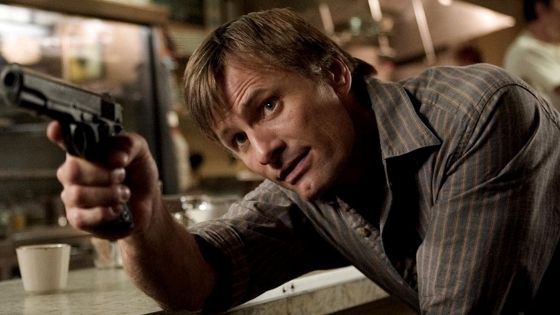
Moving to Millbrook, Indiana, an archetypal all-American town, we meet Tom Stall, a family man, small business owner, and all-round mild-mannered good guy. When the two desperado’s we encountered earlier burst into his diner and demand the takings, Tom bursts into action and kills both of them.
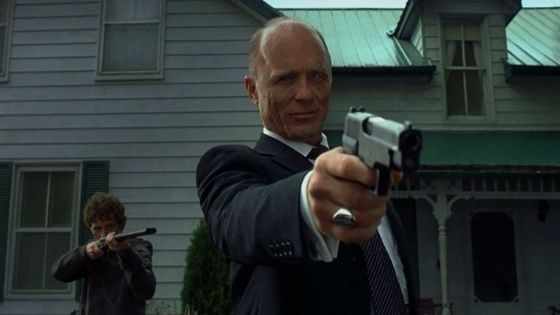
Hailed as a hero, his loving wife, Edie, begins to suspect there’s more to her apparently saintly husband, when a scarred figure turns up claiming to have known Tom as a vicious killer from his days in Philadelphia. Pretty soon, the family finds itself stalked, as Carl is determined to get revenge for what he says are Tom’s old crimes.
There’s a fair amount to like about A History Of Violence and I’ll go into more detail about that later. One thing it does struggle with, however, is it’s central revelation. Viggo Mortensen approaches Tom as more of an intellectual exercise than a character and as a result he loses a lor of depth, particularly in the first half of the film.
His approach to the character means that it’s pretty telegraphed that Fogarty is telling the truth about Tom/Joey Cusack. As a result, while the reveal is effective, the first half of the film struggles to build the level of tension it seems to be going for. That being said, the sedate way Mortensen plays the character makes his quick explosions of violence all the more effective.
One positive the film has going for it is its gritty depiction of violence. Where other thrillers would cut away, or leave to the imagination, director David Cronenberg shows in gory, loving detail, bringing reality to several accepted genre conventions.
The film works well as a deconstruction of the ubiquitous thriller premise of a former killer being forced to confront his past through violence. Not least in the way this premise always assumes that the protagonist really has left his old behaviour behind. Here, it’s much more ambiguous-which persona is real, and which is the fake? The family man, Tom Stall? Or the killer Joey Cusack?
Typically, in these normal types of thrillers any relative of the main character are very accepting of their apparently normal fathers (and it is always a father) bloody past. Here the consequences are much more apparent. His wife is alienated, disgusted by herself for still being attracted to him, and his son can’t help but call him on his hypocrisy when he tries to chide him for beating up a bully. By the end of the film, it’s unclear if Tom even has a family that he can go back to, in a powerful ending.
However, other than the effect on his family, and the question of which side of Tom/Joey is the dominant one, the film doesn’t massively explore it’s thoughts on violence. There is some lip service to the link between masculinity and violence, with the admirable suggestion that that turning the other cheek is more masculine than conflict, but other than that there is still a degree of intellectual blank space at the heart of the film.
In this respect, the films aims to be an arthouse thriller, but can’t quite meld the two together, resulting in a film that’s not quite either or. This isn’t necessarily a bad thing, and at times it resembles the thinking man’s John Wick (If you squint)
There are some strong performances-William Hurt is a memorable highlight, even though he only briefly appears, and Ed Harris brings his signature brand of malevolence to Carl Fogarty- but overall the film doesn’t quite manage to meld it’s ambitions to reality. That doesn’t mean that A History of Violence, is a bad film, but it does mean it doesn’t quite rise to greatness, despite it’s interesting premise and thoughtful execution.
Verdict: 3.5/5
- I didn’t even mention it in the body of my review, but Tom and Edie’s sex scene at the start just seemed really weird to me. Apparently it’s the first time 69 has been shown in cinema, so…..well done?
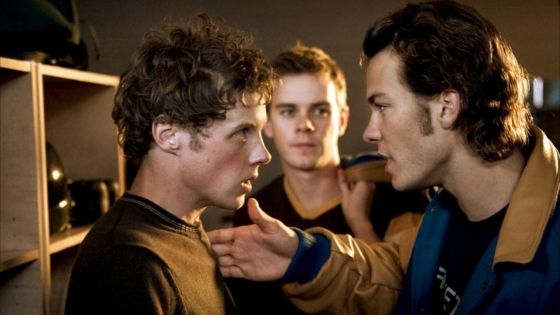
- It was so satisfying seeing Jack stand up to his scumbag bully. I think I may have cheered.
- One of the thugs right from the start is Stephen Mchattie, who plays Grant Mazzy in Pontypool, a film I will have to review for this column at some point.
Next Week: Again, I need to get back onto Hidden Gems. Next week for sure, I promise.
A History of Violence is available on Amazon Prime, DVD, Blu-ray and digital download.
Thank you for your sharing. I am worried that I lack creative ideas. It is your article that makes me full of hope. Thank you. But, I have a question, can you help me?